Română






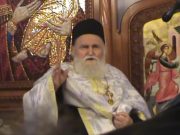





In this recording, Archimandrite Athanasios Mytilinaios (1927–2006) answers practical questions on daily Orthodox prayer: how morning and evening prayers should be kept, whether crossing oneself counts as prayer, reading prayers in modern Greek translation, and establishing a realistic daily prayer rule with Compline, Matins, and personal petitions.
Romanian translation by Elena Dinu Audio source: “Answers to questions“, no. 698 (in Greek), March 27th, 1994
Thumbnail image © asceticlifeofmotherhood
Q: “How should evening prayer be said? What should we read, and what should we pray for? Is it acceptable to read prayers in translation (Modern Greek)?”
A: Well! First and foremost, we must say our prayers both morning and evening, children! I assure you that few children—and adults, for if the adults have gone astray, the children will have learned this from their parents—pray only in the morning or only in the evening. Usually, people neglect the morning on account of work, school, or other duties, and pray only at night. Many people consider crossing themselves to be prayer, but crossing oneself alone can never count as prayer. Not in the least! They cross themselves once or thrice in passing and assume they have prayed. No, certainly not, for God’s sake!
Prayer means standing before the icons in the place where one customarily prays, if such a place is available. We may find ourselves in a hotel, out in nature, or in unfamiliar lodgings, yet none of that should hinder our prayer rule. It must not hinder us! Even if one were in prison or wherever else, prayer must be kept without fail, both morning and evening. Whether one is a student, a soldier, or anyone else, wherever and however one may be—even sick in bed, whether able to rise or not—one must pray. Even if the physician ordered, “Do not get up; do not move from bed!”, that does not mean prayer ceases. Naturally, we stand for prayer, but what if one is bedridden and forbidden to stand, or simply cannot stand? Shall that soul omit prayer? Morning and evening!
This principle is attested in the Old Testament, in the Wisdom of Solomon. The Wisdom of Solomon states the following in paraphrase. Listen closely: “Lord, just as the manna fell, which was not destroyed by fire”—for they gathered, kneaded, and baked it—”yet melted at the first rays of the sun”—though enduring the fire, it dissolved before sunlight—”even so, Lord, do the deeds of men dissolve when they begin the day without morning prayer.” Would you have your daily affairs go awry, dissolve, and bear no fruit? Children, never neglect morning prayer! Nor evening prayer, of course!
What should we say during prayer? As the question asks: “How should evening prayer be said?”, “What should we read?”, and so on. First of all, there is no harm in reading from a translation when archaic vocabulary is unfamiliar, provided an accurate translation is available. Certain prayers, however, are best recited in their traditional form without translation, such as the Lord’s Prayer. Truly, is there anyone who does not know the Our Father? The Doxology (“Glory to the Father”), the Trisagion (“Holy God”)—these we do not alter into modern paraphrase. The same applies to “O Heavenly King” and “All-Holy Trinity.”
These prayers we recite verbatim without modernization. We are accustomed to them from childhood and hear them constantly in church. Even illiterate folk who do not know the alphabet still know by heart the Our Father and “O Heavenly King.” They know them! As for other prayers, if they are difficult to comprehend, it is better to read them in translation where one exists. The same goes for reading a psalm in translation. Glory be to God, the entire Psalter is translated.
What services should we read? In the evening—I cannot impose a rigid rule here, but I offer guidance for each to apply according to discernment—we customarily read Compline. In the morning, we customarily read selections from Matins, portions of the Six Psalms, and a prayer to our patron saint. Beyond these, there are the shorter prayers: the Trisagion Prayers, two or three psalms, and the Prayer upon Rising from Sleep: “Having risen from sleep, I thank Thee, O Holy Trinity, that through Thy great goodness and long-suffering…”, and so forth. Such texts are appointed as morning prayers.
Pray as you can, according to your ability, only do not abandon prayer! If you have time, pray more. If time is short, pray less. This varies, and no rigid measure can be dictated for everyone. Some pray for five minutes, others a quarter of an hour, others half an hour, an hour, two hours, or three. Each according to ability and available time.
I would hope that in this discipline we might all make spiritual progress. I would wish that we do a little more from time to time. We may also offer prayers of our own composition. By this, I mean our personal petitions. We may pray that God illumine us where we feel bewildered, grant us understanding, help us cut off a passion, or keep us from falling into sin this day, bearing in mind our spiritual vulnerability—perhaps a temper, perhaps an envious eye. Let us cry out: “We are carnal men; Lord, preserve me this day that I fall not into sin!”
In the evening, we give thanks if we accomplished good through His help. Or did we fail? Then let us seek forgiveness in our evening prayers: “Lord, forgive me; I have stumbled, and I acted heedlessly!” And so on. What truly matters is keeping prayer morning and evening. The duration of prayer depends on personal capacity, provided the quality of the prayer is sound: said with watchfulness, reverence, and a fervent heart. Only then can we speak of fruitful prayer. This is my answer, limited to the question asked, for I am not undertaking here a broader treatise on prayer.