Română


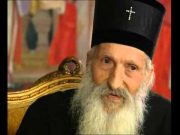






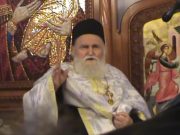




In this recording, Archimandrite Athanasios Mytilinaios (1927-2006) answers the question of what existed outside the Garden of Eden before the fall of man and where Paradise was actually located. He explains the geography of ancient Mesopotamia, the biblical prophecies surrounding the Euphrates River, and the future battle of the 200 million soldiers mentioned in the Book of Revelation. The elder also makes a distinction between the ancient earthly Paradise, the temporary spiritual Paradise where the righteous currently dwell, and the eternal Kingdom of God, reminding us of the importance of cultivating our own “inner Paradise” today.
Romanian translation by Elena Dinu
Audio source: “Answers to questions”, no. 567 (in Greek), January 10th, 1993
Fr. Athanasios:
Here is a very interesting… [question]. It asks: “What existed outside of Paradise at that time, before the first-created were expelled? Did continents exist, namely Africa, Europe, Australia, America, as they are today, and did other animals, fish, and so on exist? And when we say that during Noah’s flood the whole earth was covered by water and all the people drowned, are we referring to Africa, America, Australia, and the rest, or only to the region called the Middle East today?”
Well then! Therefore, learn, children, once and for all, and know that there is a great deal of confusion surrounding the topic of Paradise. Paradise, as described by Holy Scripture, was clearly a place on earth, a delimited place. It had, that is, boundaries—this is what “delimited” means: it had boundaries—it had limits. And it was located where Iraq is today, namely ancient Mesopotamia, which was surrounded by four rivers—or if you will: two rivers and two tributaries. They are: the Tigris and the Euphrates, the Gihon and the Pishon.
Some have said that the Gihon is the Nile. No, it is not! They are only tributaries of these two great rivers. Be that as it may, Paradise is delimited; that is, it has boundaries. Thus, that place was called “Paradise” in relation to the rest of the earth’s surface.
It says clearly, of course, that although God made the trees, the animals, and everything else down on earth, He showed a special care for that specific place. And God planted, it says, trees in Paradise, and so on: something more exquisite, something better. Of course, when we say that the first-created were expelled, Paradise was down on earth. When I was little—not too little, maybe like you, I don’t know—I used to think that Paradise must have been in heaven. And then they ended up on earth: meaning, did they fly from heaven and jump down to earth?
How could that be? Of course not! For Paradise was down on earth—very simply! A delimited place, with limits, with boundaries. And when they go out of it—for God expelled them, it says—what does this mean? That they went out of that place, to another part of the earth.
This is what it means that they went out of Paradise: they went to another part of the earth. At the same time, Paradise is a type of the true Paradise, that is, of the Kingdom of God. For let us not forget that today, Paradise is anything but a paradise there in Iraq. It is anything but a paradise! Many battles have been fought there throughout history.
And it is foreseen that there will be a terrible and fearsome battle there: it is the final battle in the history of humanity. It is foreseen that two hundred million soldiers will clash there. Terror! You will say: “Two hundred million?” Yes, Holy Scripture says it clearly, and the Book of Revelation says it! And of course, it implies that three states will be involved there.
Anyway, this Paradise no longer exists; it has relocated. When Christ said to the thief: “Today you will be with me in Paradise,” which Paradise? That one, the old one, on earth, with beautiful trees, or the one between the rivers Tigris and Euphrates? No! Where? Paradise has relocated.
What is it? Now it is the “place”—the word “place” in quotation marks—of the world beyond, where souls go, and in this place the righteous are found. This Paradise—the spiritual Paradise—was created at the same time as Christ’s descent into Hades. It did not exist before. Once Christ entered Hades, that place became Paradise. You have also seen the Orthodox icon of the Resurrection, in which Christ takes Adam and Eve together with Himself!
That is when Paradise was created! For the very first time! Therefore, we would say that the first one to enter this place, into Paradise, is the thief! “Remember me,” he says, “in Your Kingdom!” “I assure you that today”—today, right now, before the sun sets!—”you will be with Me in Paradise.”
This is Paradise today. But what is this? Only the spirits of the righteous! It is temporary: when the resurrection of the dead takes place, the spirits of the righteous and of the saints will no longer be there. For now they are all there: the Forerunner is there too—except for the Theotokos—and the apostles are there too, but then this Paradise will be abolished.
Why? The souls of the righteous, of the saints, will take back their human bodies which they lost at death. It is what we confess: The Resurrection of the dead! And then, as complete humans, with body and soul, they will enter the Kingdom of God. That is: “Come, you blessed of My Father, inherit the kingdom prepared for you.”
Then they will enter the Kingdom of God. No one is currently in the Kingdom of God, except for Jesus Christ, with His human nature, and, as our Church says, the Theotokos as well. No one else! Therefore, the Paradise of today, the spiritual one, has a temporal character. The Kingdom of God, then, differs from Paradise.
If you see in the Fathers of our Church, in the books you read, that they alternate the terms “Kingdom of God” and “Paradise,” it is not wrong. He who is today in Paradise will undoubtedly be tomorrow in the Kingdom of God! But if we must speak with exactness (akriveia), it is as I am telling you now. But, as I told you, the old Paradise—that of Adam and Eve—was a type of the Kingdom of God. Not of the Paradise of today, but a type of the Kingdom of God!
Why? Because Paradise, for Adam and Eve, was both an external phenomenon, as the Fathers say, and an inner phenomenon. When God told the first-created to till and to keep Paradise—from whom? An entire region, how were they to keep it, and from whom? There was no one else; there were no evildoers! He was referring to the inner Paradise!
And what were they to till? To dig and to water? It says clearly that water went up and watered Paradise. There was no earthly reason for that. Rather: “To water and to cultivate the inner Paradise!”
That is why Christ said: “The kingdom of God is within you.” Did He not say so? Meaning, the first-created had to carry Paradise within their souls, in order to keep God’s commandments. Today, by keeping God’s commandments, we already have as a foretaste, not Paradise, but the Kingdom of God within us. Christ said: “The kingdom of God is within you”!
What is this? It is a subjective thing: it is possible that I am now experiencing the Kingdom of God, while you are experiencing hell. How many people are there who experience the reality of hell and we say: “Alas, this person! It is terrible! He is experiencing the reality of hell!” We see the other person suffering horribly!
Thus, man experiences both the Kingdom of God and hell subjectively. Take heed! These will also exist objectively. Since hell also exists outside of man—that is what “objective” means. And the Kingdom of God also exists outside of man, objectively that is, so that, if today we do not experience the Kingdom of God—or Paradise—within us, neither will we experience it there, objectively.
St. Symeon the New Theologian says this clearly. Therefore, as you understand, this is how things stand, and let us view them in this way so that we may remain properly oriented. Because our time has run out, we will continue, with the Lord’s help, next Sunday!