Română
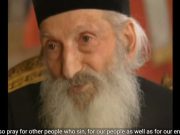










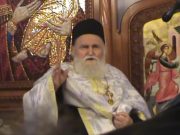





In this recording, Archimandrite Athanasios Mytilinaios (1927-2006), answers the question: “Can the souls of the deceased hear, see, or understand what people say or think about them?” Do the souls of the dead see us? Can they hear our prayers or thoughts? Archimandrite Athanasios explains us what happens to souls after death, where they go, and whether they can communicate with the living.
Audio source: “Answers to Catechism questions“, no. 837 (in Greek), October 22, 1995
Fr. Athanasios:
There are some questions that come up repeatedly, but it is not a problem. Whether it is because someone missed a previous sermon and did not hear the answer to a particular question or because a long time has passed, or even because of new attendees; this is not an issue. However, when it is something that has been asked before, we will answer briefly.
So, here is a question that was asked tonight: “Could you please tell us if the souls of the deceased can hear, see, or understand what people say or think about them?”. Well, I do not always mention the “thank you” that the question contains. I enjoy seeing this “thank you” because it is an integral part of almost every question. In the past, I had advised you to use it and I congratulate you for doing so. We must always say “thank you” and “you are welcome” and be kind to everyone. If we do not learn these things in our youth, we will be rude as adults.
Let us now answer the question about whether the souls of the deceased can hear and see. The answer is clear. No, children, the souls of the dead do not hear or see. As St. John Chrysostom explains, the soul of each person upon leaving the body goes to the “familiar place”. The place where it is destined to go. Whether it is Hades or Paradise, depending on the person’s deeds, since neither Hell nor the Kingdom of God have yet opened their gates, as we have mentioned many times. These events will only occur after the final judgment and the resurrection of the dead.
At the moment, the souls are in an intermediate state. Of course, those who went to Hades are in a place of torment, as we are reminded by the parable of Lazarus and the rich man. This is certainly a place of suffering, as the parable describes, but Paradise is a place of joy, a place of gladness, which was inaugurated by Christ after His descent into Hades. However, in both of these places the souls are bodiless. So, when the resurrection of the dead occurs people will become whole again; they won’t remain bodiless and both in Hell and in the kingdom of God they will regain their bodies. This is an important point I keep repeating because there is a false understanding about these matters and it is important to know the truth.
Now, returning to the question, the souls of the deceased that end up in Hades cannot communicate with each other. One of the torments of Hades, and of Hell at a later stage, is the lack of communion. Each soul experiences an immense loneliness, a terrifying solitude. Imagine being in a place where the night never ends, the time passes, and there is no one to speak to, not a single person with whom to exchange a word. So, this is the first punishment: loneliness.
The Church Fathers often reflect on this, saying that one of the great goods in life is to experience the presence of others, to see their faces. Therefore, one of the greatest privileges that people will experience in Heaven, as the Evangelist John describes in the Book of Revelation and in his first Epistle, is the ability to see the face of Jesus Christ: “We will behold His face as it is” and all the joy will be in our ability to see Him.
St. John Chrysostom weeps about those going to Hell, not because of its torments, but because they will be deprived of seeing the peaceful face of Jesus Christ. Thus, in Hell there are no faces to see, there is only nothingness. The Fathers, particularly the ascetics of the desert, have given examples to help us understand this. They say that these souls will be like Siamese twins who are attached back-to-back with each other, so that they can never see each other’s faces. It is a symbolism to emphasize the inability to see faces, an imagery of complete solitude.
In contrast, the souls of the righteous, the saints, and the great figures of our faith are in Paradise; even now before the resurrection of the dead. Although they do not see or hear directly, they communicate with each other and they must also communicate with the living through the angels. That is why we pray to the saints; when we pray to St. Demetrius, for example, he is not physically everywhere, but he receives our prayers through the angels or by other means that only God knows. God answers our prayers and performs miracles because He wants to glorify those who have glorified Him: “Please, St. Demetrius, grant me this”, and we receive it. Thus, we can say that only the souls that are now in Paradise can hear or see us, even though not directly. These are the things I wanted to share with you in response to this question.