Română


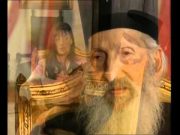

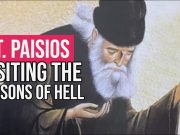
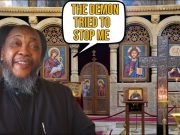






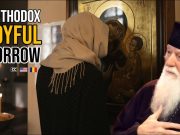
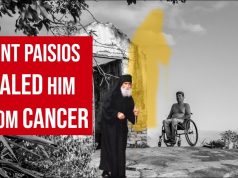
In this video, Fr. Evangelos talks about the meeting of St. Paisios with Stamatis (a homosexual man). This is the testimony of a direct witness. At that time, Fr. Evangelos Papanikolaou was a novice on Mount Athos and he knew St. Paisios very well. Now he is a physician and serves as a priest in Greece.
Video source: Antonis Tzatzanis
Monastery of Our Lady of the Angels (Gouverneto), Crete, Greece, (2018?)
Fr. Evangelos:
“What’s your name, my child?” I asked him.
“Stamatis,” he answered.
“Stamatis, my child, don’t you know that you need to bring warm clothing to Mt. Athos?”
“I had no idea …”
“I took the airplane, then I took a taxi …”
We thought to ourselves, “Imagine how much money he earns to be able to afford an airplane [and a taxi] to Mt. Athos …”
He was also really good-looking! His was Greek-German. His father was Greek and his mother was German. A handsome and a masculine guy.
[While conversing with him on Mt. Athos], he told us, “Can you take me with you and show me around Mt. Athos? I have no idea [what to do here]?”
“Sure, we will,” I said.
“Please, I also want to visit Saint Paisios.”
I thought to myself, “Pfff, I was there only six hours ago. Now, I have to climb the mountains again, go ring the bell [of St. Paisios’ cell], probably hear him say, ‘You were here a moment ago, chubby, now what do you need?’ [Then], go take the bus, cross, climb down, show the cross in the sea, leave, go to Karyes, then down to Dochiariou [Monastery]. The abbot of Dochiariou will be waiting for us … He swears a lot, too. He’s not a soft man. What have I got myself into? Why did I have to start a conversation? Now, you have to go back to Saint Paisios …”
I became mad at myself. You have a right to go through all these [worries]. In the end, however, you have to answer, “Yes, … because [this man] is Christ.”
So I told him, “My brother, we’ll break the cycle. We are going!”
Here we go again. We were carrying our luggage on our back, he barely had anything. He was traveling with scarpins (men’s low shoes), we didn’t have anything to give him to wear instead. We made him a walking stick so that we could climb the muddy, frozen paths.
It’s a downhill [path] at first, but then it turns into an uphill one [to get to Saint Paisios cell at Panagouda, Mt. Athos]. [Once we arrived,], we rang the bell [of his cell] and Elder Paisios came out. It had rained yesterday and his cistern was full of water. So he wanted us to pump the water [from the tank] again in order to clean the tank from any leftover debris.
“Welcome, guys!” Saint Paisios told us. He took us inside. The same job all over again: pump the water [from the tank] to clean it from the debris. [In the meantime], he took Stamatis in privately to talk with him.
He was saved! I will to explain why later. They talked in private, a few meters away from us. Stamatis was Greek-German and knew Greek. While they were talking, Stamatis started shining. The darkness of his face was withdrawing, and he was shining, shining, shining …
Elder Paisios then told me, “Evangelos, come here. From this point on and for the rest of your life, it is your duty to pray for a reposed man named Michalis. No matter whether you become a priest or not [in the future], you’ll pray for [this man’s soul] for the rest of your life.”
Elder Paisios [turned to] Stamatis and said, “You don’t have the right to pray for Michalis anymore. Evangelos has taken on this responsibility from now on.”
[Going back to Stamatis’ story:] When we first met each other at Iveron [Monastery] I had asked him, “Why did you come to Mt. Athos?” “A friend of mine died, and I’ve come to Mt. Athos to pray for his soul,” he answered.
I am a doctor, so I can be a bit clever sometimes. Had you asked me, “Why have you come to Mt. Athos?” I would have answered, “A friend of mine died of leukemia or a friend of mine died of cancer, or a friend of mine died of stroke, and I’ve come to pray for him on Mt. Athos.” But he didn’t mention the cause of his friend’s death. And as a doctor I figured out that the friend had died of AIDS.
As you know, in those days AIDS was always correlated with homosexuality. Therefore, we didn’t say anything to avoid saddening him.
As we were leaving, Elder Paisios took Stamatis in his arms like this and told him, “My Stamatis, have no fear! If you managed to trick me so that I understood nothing [about you], imagine how [much easier] it will be to trick the toll-houses!”
It was as if Saint Paisios was telling him: “I would have normally been able to understand your [sinful] passion [through God’s enlightenment]. Yet God concealed it from me until you told me about it.” I wasn’t able to understand anything. I was only witnessing all these events, at the time. I am now explaining them to you in hindsight.
So Saint Paisios told him, “My child, have no fear!” He gave him a little smack, like this and told him, “My child, I’ll commemorate you forever …”
Now it is time to say who Stamatis was, and what was his reason to visit Mt. Athos. Stamatis to me is a saint. I commemorate him in my prayers as “Monk Stamatis.” Stamatis was born in Germany from a Greek father who was a bit brutal. The mother who raised him was German and had this short of “instructor” style. The kid turned out really good-looking. They sent him to a gym and at the gym someone approached him … Anyway, this tendency of love and affection towards the same sex began.
Stamatis came to Athens. He was a professor at Goethe and earned a very good salary. There, he met a bank employee with whom he developed a relationship. This was Michalis the one Elder Paisios spoke of, saying: “You won’t commemorate him ever again. Evangelos will commemorate him from now on — but you will not ever again!” Poor Michalis had fallen sick with AIDS. Stamatis had such crazy love for him which made him say, “I will also get AIDS, so that we can be sick together…”
Be careful now — this is a spiritual illness. What does it demonstrate, though? It shows that we must really careful how we talk about such an intense [sinful] passion. I want to point where Elder Paisios comes into [this story], so that I can also demonstrate how he dealt with the passion [of homosexuality].
Michalis became sick from AIDS. At the time, there were not many medical treatments for this condition. Now, most of the people with this condition are dealing with it. They get a health care benefit of 800 euros from the state, the cost of the treatment is 2000 euros. Whereas a woman who has breast cancer only gets 400 euros. That’s exactly how the healthcare system operates. We’ve gone from one extreme to the other.
Michalis was sick and hospitalized. Michalis’ parents wouldn’t allow Stamatis to visit him in the hospital. Yet Stamatis was spending day and night outside St. Savvas’ hospital to hear any news. When he would get word that Michalis lost weight weighed 110lbs, he would also lose weight in order to reach 110lbs. Michalis went to 100lbs, Stamatis followed; at 95lbs, the same thing happened. Finally, Michalis died.
After his death, Stamatis said, “My God, what should I do for the one I love?” They told him to go to Mt. Athos and tell the Fathers [there] to pray for the salvation of his soul. The [sinful] passion [of homosexuality] brought him to Mt. Athos! That’s why you must be very careful [not to judge].
Poor Stamatis didn’t know what Mt. Athos was. He thought it was a meeting place just like Kolonaki square [in Athens]. Thus, he came to Iveron [monastery], where the first, royal holy icon of Panagia on Mt. Athos is kept. So, he came [to Mt. Athos], and that’s how we met. He asked us to take him to Elder Paisios. Indeed, he visited Elder Paisios.
Elder Paisios told him: – Stamatis, can you fast on Wednesdays and Fridays?” – Yes, I can! – You earn so much money from the German college, you’ll keep one tenth for yourself and the remaining nine tenths you will give to the poor. Can you do that? – Yes, I can! Can you pray the Akathist Hymn to the Theotokos every day? -Yes, I can! -Stamatis, can you go to the hospital once a week and take care of some sick man who has nobody to care for him? – Yes, I can! — These are the saints of God! Pay attention to what follows! — – Stamatis, can you go find a spiritual father and confess? -Yes, I can! – Can you follow the penance your spiritual father will prescribe? – Yes, I can! – Can you go to the Divine Liturgy every Sunday? -Yes, I can!
So, Elder Paisios said, “Go and do what you can … and God will do for you what you cannot [do for yourself].” Did you understand what he told me? Go and do whatever you can, and let God fight your [sinful] passion for you. Let God do for you, what you cannot [do for yourself]: Fight this [sinful] passion that drags you down.
Elder Paisios also set a condition, “You’ll never remember Michalis again. Nor will you commemorate his name in your prayers for the departed. He [Fr. Evangelos] will take care it. Go bring him here.”
Well, the first person I commemorate among the reposed after my spiritual father, elders and Fr. Timothy, the first one I commemorate is the servant of God Michalis. Why? Because it’s an instruction from Saint Paisios.
Have you ever seen an angel of God? One of God’s angels! The grace of the Holy Spirit covered Stamatis and he lived the rest of his life in a tremendous spiritual state. Fasting, all-night vigils, prayers, prostrations, confession. He devoted himself …
Whoever was sick with AIDS and had not confessed, Stamatis would get a spiritual father for him so that he could confess. At the time, priests were hesitant to give Holy Communion to AIDS patients. So he found a priest who was willing to give them Holy Communion, and he would drive him with his car at any hour of the day; in this way the AIDS patients could receive Holy Communion.